Midjourney Review 2026: Is It Still the Best AI Image Generator?
Midjourney remains one of the biggest names in AI image generation, but competition from ChatGPT, Gemini, FLUX and other platforms is stronger than ever. We review Midjourney V8.2, its image quality, editing tools, pricing and whether it is still worth using in 2026.
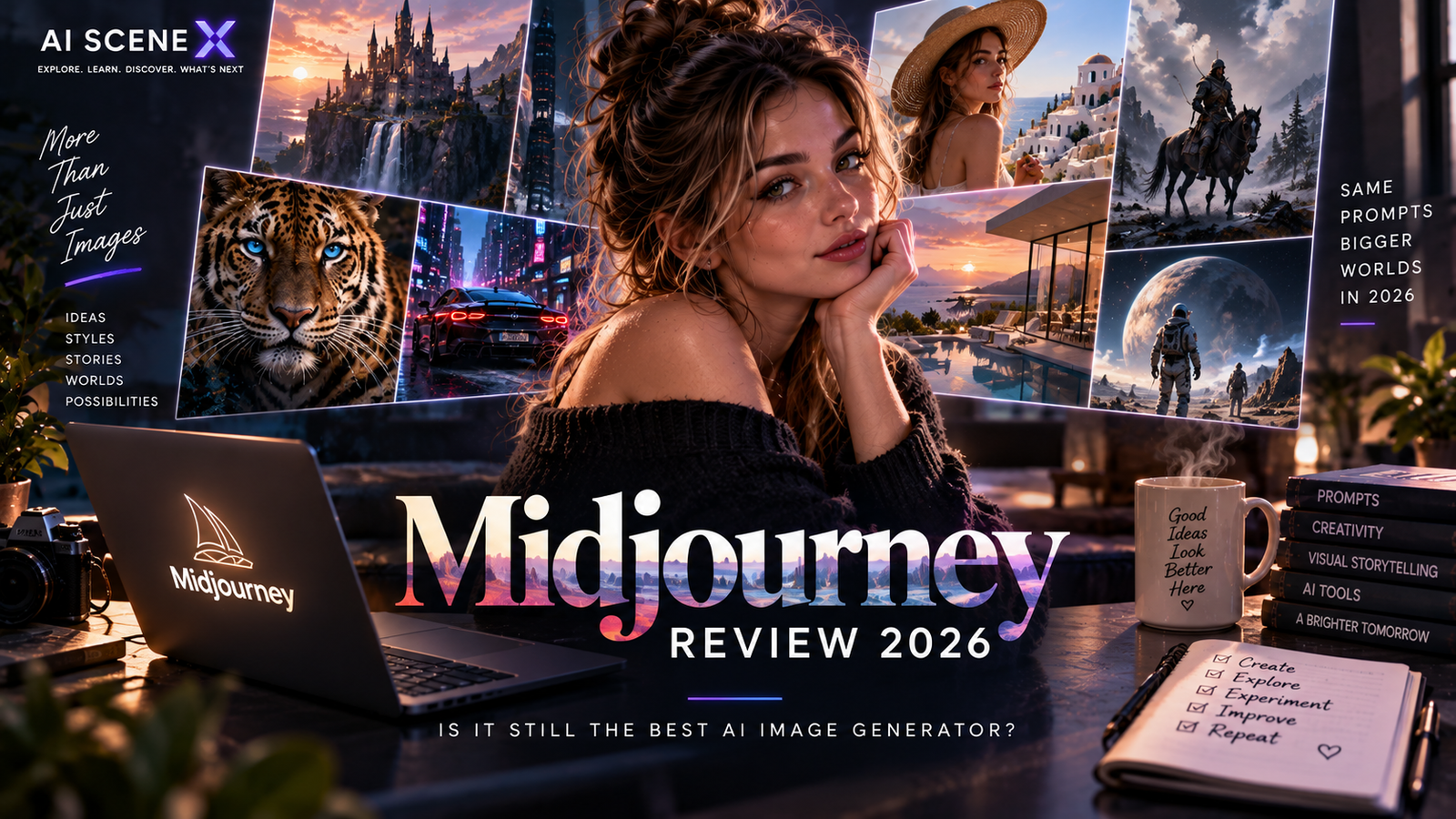
Midjourney helped define what AI art could look like
Few AI products have influenced the visual side of generative AI as much as Midjourney.
When AI-generated images first began reaching mainstream audiences, Midjourney quickly became associated with one thing:
beautiful images.
Its cinematic lighting, dramatic compositions and highly polished aesthetic made AI art look less like a technology demonstration and more like professional creative work.
But the market has changed.
ChatGPT can generate and edit images conversationally.
Google is investing heavily in Gemini image generation.
FLUX has become a serious option for advanced creators.
Ideogram is strong with typography.
Adobe is integrating generative AI into professional creative workflows.
So Midjourney no longer wins simply by being impressive.
It has to compete.
And in 2026, that makes the question much more interesting:
Is Midjourney still the best AI image generator?
What is Midjourney?
Midjourney is an AI platform for generating images — and increasingly video — from text and visual references.
Users describe an idea, and Midjourney interprets that prompt into generated visual concepts.
The platform has evolved significantly from its Discord-heavy beginnings.
Today, users can create directly through the Midjourney website using the Imagine bar, explore previous creations, organize images, edit results and control aesthetic settings without depending entirely on Discord.
That makes the modern Midjourney experience much more approachable than earlier versions.
Midjourney V8.2 is the current default model
Midjourney V8.2 became the platform’s default image model on July 24, 2026.
According to Midjourney, V8.2 focuses particularly on:
aesthetics,
image quality,
and Personalization.
The company describes V8.2 images as more creative, bold and sophisticated, while its personalization system is designed to understand a user’s aesthetic preferences more effectively.
V8.2 also works with HD image generation, allowing output up to 2048 pixels without relying on a traditional upscale step.
For creators who care primarily about visual quality, these improvements matter.
Image quality remains Midjourney’s biggest strength
Midjourney’s greatest advantage is still remarkably simple:
It makes beautiful images.
That sounds subjective because it is.
There is no scientific benchmark for whether one fashion editorial, fantasy landscape or cinematic portrait is more attractive than another.
But Midjourney has developed a recognizable ability to produce images with:
strong composition,
interesting lighting,
atmospheric depth,
rich textures,
cinematic framing,
and polished color relationships.
This makes it particularly strong for images where mood matters as much as accuracy.
Think:
fashion concepts,
editorial photography,
fantasy environments,
cinematic scenes,
architecture,
concept art,
luxury product imagery,
album artwork,
and visual storytelling.
For those jobs, Midjourney remains one of the first platforms we would consider.
Midjourney has become much better at following prompts
Earlier AI image generators frequently treated prompts as suggestions.
You might ask for six specific details and receive three.
V8.1 significantly improved prompt understanding and retention of small details, while V8.2 builds on the newer V8 generation.
Midjourney also provides Raw Mode for creators who want to reduce the platform’s automatic stylistic interpretation.
In standard mode, Midjourney adds more of its own creative aesthetic.
Raw Mode reduces that influence, which can produce more realistic or more directly controlled results when the prompt already contains detailed stylistic instructions.
That is important because Midjourney’s biggest strength can occasionally become a weakness.
Sometimes you want Midjourney’s taste.
Sometimes you want it to simply follow instructions.
Raw Mode helps separate those workflows.
The new Edit Model is a major improvement
One of Midjourney’s historical weaknesses was editing.
Generating something beautiful was easy.
Changing one specific part without disturbing everything else could be much harder.
The V8 generation addresses this with Midjourney’s new Edit Model.
It can modify an existing image through written instructions, generate new images using up to four reference images and perform localized editing through inpainting and canvas expansion through outpainting.
This replaces several older reference workflows for V8 users.
That means a creator can increasingly treat Midjourney as more than a slot machine that produces four new images every time.
You can start with a visual direction and continue refining it.
That makes Midjourney considerably more useful for actual production.
Reference images are much more useful now
The new Edit Model supports up to four reference images.
Those references can be combined with other Midjourney systems including:
Style References,
Moodboards,
Personalization,
Image Prompts,
and HD generation.
This creates much more sophisticated workflows.
A creator might use one image for a subject, another for composition and a broader personalization profile to influence the overall aesthetic direction.
That begins to move Midjourney from simple prompt generation toward something closer to an AI creative studio.
Personalization is one of Midjourney’s smartest features
Most AI image platforms start every user from essentially the same model.
But visual taste is personal.
One person prefers bright commercial photography.
Another likes dark cinematic imagery.
Another wants minimalist editorial design.
Midjourney’s Personalization system attempts to learn those preferences.
V8.2 specifically improved this capability, including a larger image pool for building personalization profiles.
This is potentially very powerful.
The future of AI image generation may not simply be:
Which model is best?
It may be:
Which model understands my taste best?
Midjourney is clearly moving in that direction.
Draft Mode makes experimentation faster
Creative work often requires many bad ideas before finding a good one.
That makes generation speed important.
Midjourney’s Draft Mode is designed for rapid experimentation.
With V8.1 and V8.2, a Draft prompt generates a large batch of 24 lower-resolution 512×512 images for 0.4 minutes of GPU time. Creators can then take promising concepts and regenerate variations at higher quality.
This is a clever workflow.
Instead of spending full generation resources trying to perfect the first prompt, you can explore many directions quickly.
Find the idea.
Then polish it.
Midjourney can generate text — but this is not its greatest strength
AI-generated typography has improved enormously.
Midjourney supports text generation by placing desired words or phrases inside double quotation marks.
The platform recommends shorter phrases and notes that standard Latin-alphabet text generally works best.
That qualification matters.
Midjourney can create impressive posters and graphics containing text.
But if exact typography is mission-critical, we would still consider tools designed more specifically around graphic design and text rendering.
For a cinematic image containing a short neon sign?
Midjourney can be excellent.
For a poster containing multiple paragraphs of perfectly formatted copy?
Use a design tool for the final typography.
Midjourney is no longer just an image generator
One of the biggest changes to the platform is video.
Current Midjourney subscriptions include video capabilities, with SD and HD availability varying by plan.
The platform’s pricing structure also now distinguishes between image and video generation, with unlimited Relax Mode video generation available on higher tiers.
This matters strategically.
AI image platforms are increasingly becoming visual-generation platforms.
The distinction between:
image generator,
video generator,
editor,
and design environment
is gradually disappearing.
Midjourney is moving with that trend.
What Midjourney does best
1. Cinematic imagery
This remains its signature strength.
When you want something that feels dramatic, polished and visually expensive, Midjourney is extremely difficult to ignore.
2. Artistic interpretation
Midjourney often adds something beyond the literal prompt.
Sometimes that is exactly what you want.
It can transform a relatively simple idea into something much more visually interesting.
3. Concept development
Moodboards, style references, personalization and Draft Mode make Midjourney excellent for exploring visual directions.
4. Fashion and editorial imagery
The platform’s aesthetic strengths naturally suit fashion concepts, editorial portraits and stylized commercial imagery.
5. Fantasy and world building
Environments, architecture, creatures and cinematic worlds remain areas where Midjourney can produce spectacular results.
Where Midjourney is weaker
No platform wins everything.
Precise editing can still require patience
The new Edit Model is a substantial improvement.
But AI editing remains probabilistic.
Asking an AI to change exactly one detail while preserving every other pixel is fundamentally different from editing manually in Photoshop.
Sometimes it works beautifully.
Sometimes several attempts are necessary.
Midjourney has a strong aesthetic bias
This is simultaneously a strength and weakness.
Midjourney likes making things look good.
But “good” and “exactly what I asked for” are not always the same thing.
Raw Mode helps, but creators requiring highly literal output may sometimes prefer other workflows.
Text is not perfect
Text generation has improved considerably, but complex typography should still be checked carefully.
There is no normal free plan
Midjourney currently requires a subscription for normal use. Its documentation says there is no free trial through Discord or the Midjourney website, although a limited trial is available through the niji · journey mobile app.
That creates more friction than competitors that allow people to experiment before paying.
Midjourney pricing in 2026
Midjourney currently offers four primary subscription tiers.
| Plan | Monthly | Annual equivalent | Fast GPU time |
|---|---|---|---|
| Basic | $10 | $8/month | 3.3 hours |
| Standard | $30 | $24/month | 15 hours |
| Pro | $60 | $48/month | 30 hours |
| Mega | $120 | $96/month | 60 hours |
Annual subscriptions receive a 20% discount but are paid for the full year upfront.
The differences are important.
Standard adds unlimited image generation through Relax Mode.
Pro and Mega add Stealth Mode for private creations and unlimited SD video generation through Relax Mode.
Additional Fast GPU time costs $4 per hour.
For many serious individual creators, Standard at $30/month is probably the most interesting starting point because unlimited Relax image generation changes how freely you can experiment.
Privacy deserves attention
This is easy to miss.
Midjourney describes itself as an open-by-default community, meaning generated work can potentially appear through its Explore environment.
Stealth Mode is the feature designed to keep creations private, and it is available only on Pro and Mega subscriptions.
For casual experimentation, that may not matter.
For client work, unreleased products, confidential concepts or private commercial campaigns, it absolutely can.
Professional users should understand this before choosing a plan.
Can you use Midjourney commercially?
Generally, paid subscribers receive broad commercial usage rights for generated assets under Midjourney’s terms.
Midjourney’s plan documentation states that subscribers can use generated images and videos in almost any way they want, while companies generating more than $1 million in annual gross revenue must use the Pro or Mega plan for commercial use.
Businesses should always review the current Terms of Service rather than relying on a review article for legal guidance.
Terms can change.
Midjourney vs ChatGPT Images
This is probably the comparison most normal users care about.
Midjourney wins for aesthetics
If our goal were:
“Create a spectacular cinematic image.”
We would currently lean toward Midjourney.
It has a distinctive ability to turn visual ideas into polished, dramatic imagery.
ChatGPT wins for conversational workflow
ChatGPT has a different advantage.
You can explain what you want naturally, inspect the result and continue the conversation.
That workflow is extremely intuitive.
For a marketer, blogger or small business owner who already uses ChatGPT for research, writing and other work, having image creation inside the same environment is powerful.
The winner depends on the user
Choose Midjourney when the visual itself is the priority.
Choose ChatGPT when image creation is one part of a larger AI workflow.
That distinction explains why both can be “best” at the same time.
Midjourney vs FLUX
This comparison is more relevant to advanced creators.
FLUX is attractive for photorealistic and technically controlled workflows, particularly when users want more flexibility around how and where models are deployed.
Midjourney prioritizes the creative experience.
If you want deeper technical control, FLUX may be more attractive.
If you want to open a platform and start exploring visual concepts immediately, Midjourney is easier to recommend.
Midjourney vs Ideogram
The distinction here is clearer.
Choose Midjourney for aesthetics.
Choose Ideogram when typography and graphic text are central to the image.
There is considerable overlap, but their strongest identities remain different.
Who should use Midjourney?
Midjourney is particularly well suited to:
artists and illustrators
for visual exploration and concept development.
marketers
for campaign concepts and eye-catching visuals.
fashion creators
for editorial concepts and styling inspiration.
filmmakers
for storyboards, environments and cinematic mood development.
game developers
for world-building and visual concepts.
content creators
for thumbnails, social visuals and attention-grabbing imagery.
designers
for rapid ideation before moving assets into traditional design software.
Who probably does not need Midjourney?
If you generate only a few images per month and already pay for another AI platform with strong image generation, an additional Midjourney subscription may be unnecessary.
Similarly, someone who needs precise production graphics rather than creative visual exploration may get more value from a design-oriented platform.
Midjourney becomes easiest to justify when visual creation itself is an important part of your work.
Is Midjourney worth $30 per month?
For a serious visual creator:
Yes, potentially.
The Standard plan’s unlimited Relax image generation makes experimentation much easier.
For someone who creates images occasionally:
Probably not.
The important question is not whether Midjourney can make beautiful pictures.
It clearly can.
The question is whether those pictures create enough value for your workflow to justify another subscription.
That is a much better way to evaluate any AI tool.
AI Scene X rating
9.4 / 10
Best for:
Cinematic imagery, artistic visuals, concept development, fashion, editorial work and creators who prioritize aesthetics.
Strengths:
Exceptional visual quality, strong artistic interpretation, V8.2, improved personalization, reference workflows, powerful Edit Model, Draft Mode and increasingly capable web interface.
Weaknesses:
No conventional free tier, advanced privacy requires higher-priced plans, precise editing can still require iteration, and the platform’s strong aesthetic instincts are not ideal for every job.
Is Midjourney still the best AI image generator?
Not universally.
And that is actually more interesting.
In 2026, there is no single image generator we would recommend for every task.
ChatGPT may be better for conversational image creation.
Gemini may be preferable for certain editing workflows.
FLUX may appeal more to power users seeking control and photorealism.
Ideogram can be a better choice when typography is critical.
Recraft may make more sense for vector and graphic-design work.
But if the question is:
Which AI image generator would we choose primarily for visual aesthetics?
Our answer is still:
Midjourney.
Final verdict
Midjourney has survived the explosion of AI image competition for a simple reason.
It still has a strong identity.
Many AI products can generate an image.
Midjourney remains particularly good at making people want to look at the image.
V8.2 improves quality, personalization and editing while the broader platform has evolved far beyond its early Discord experience.
It is no longer the automatic recommendation for everyone.
But for creators whose first priority is visual impact, Midjourney remains one of the strongest AI image platforms available in 2026.
Overall score: 9.4/10
AI Scene X verdict: Still one of the best — and our current choice for pure visual aesthetics.