ChatGPT vs Gemini 2026: Which AI Assistant Is Better?
ChatGPT and Google Gemini are two of the most powerful AI platforms in 2026. We compare them across reasoning, research, writing, coding, images, files, productivity and everyday work to find out which one is better.
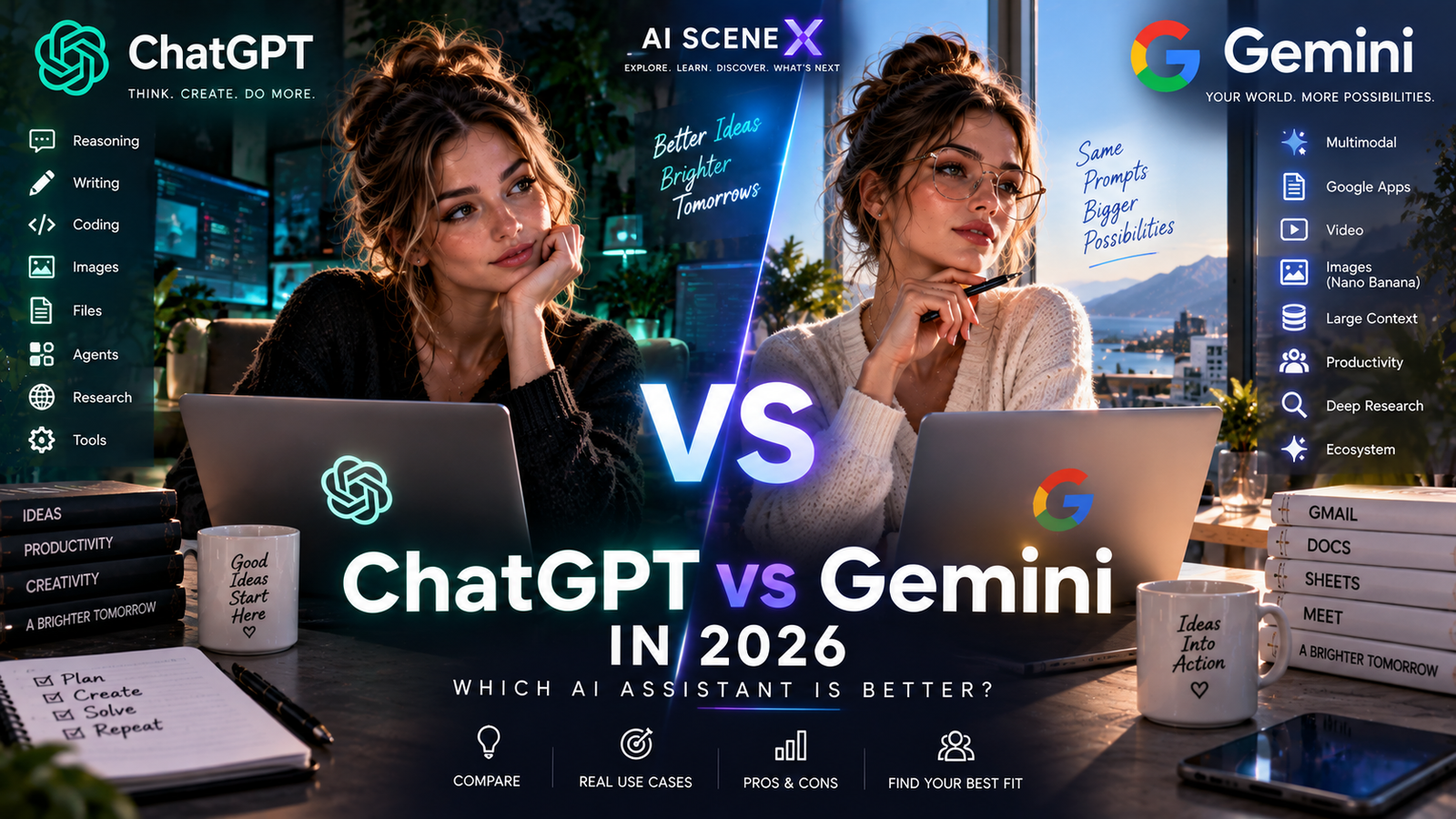
ChatGPT vs Gemini is no longer a simple chatbot comparison
A few years ago, comparing ChatGPT and Gemini mostly meant asking both systems the same questions and deciding which answer sounded better.
That comparison no longer makes much sense.
Both products have evolved into broad AI platforms capable of working across text, images, documents, research, coding and increasingly complex multi-step tasks.
But they are evolving in different directions.
ChatGPT is becoming a general-purpose AI workspace built around reasoning, tools and longer workflows.
Gemini’s biggest strategic advantage is its position inside Google’s enormous ecosystem of products and information.
So the real question in 2026 is not:
Which chatbot gives better answers?
It is:
Which AI platform is better for the way you actually work?
ChatGPT in 2026
ChatGPT is built around OpenAI’s current GPT-5.6 family.
GPT-5.6 Sol powers the more capable ChatGPT experience for eligible paid users, while GPT-5.6 Luna serves as the default model for Free and Go users.
Paid users can also choose higher reasoning levels for more difficult tasks, while Pro users have access to the highest-capability GPT-5.6 options.
But the model itself is only part of ChatGPT.
The platform combines AI reasoning with tools for research, files, images, coding and multi-step work.
That makes modern ChatGPT closer to an AI workspace than the chatbot that originally made it famous.
Gemini in 2026
Google has taken a somewhat different approach.
Gemini currently offers a family of Gemini 3 models including Flash-Lite, Flash and Pro.
Flash-Lite prioritizes efficiency.
Flash balances speed and reasoning.
Gemini 3 Pro is Google’s more advanced option for complex work, with stronger capabilities across text, files, images, video, mathematics and coding.
Google also offers adjustable thinking levels, including Standard and Extended thinking, while its highest subscription tier provides Deep Think for particularly complex problems.
But Gemini’s biggest advantage may not be the model.
It is Google.
Gemini increasingly connects AI with the ecosystem millions of people already use every day.
Reasoning
This is one of the hardest categories to judge because both platforms continue to improve quickly.
ChatGPT’s GPT-5.6 system is explicitly designed around scalable reasoning.
Eligible paid users can choose Medium or High reasoning, while higher tiers provide additional reasoning options for demanding work.
That flexibility is useful.
A simple question does not need the same computational effort as a complicated business analysis or coding problem.
Gemini takes a similar approach through its thinking levels.
Standard thinking prioritizes everyday speed.
Extended thinking gives the model more time for difficult problems.
Google’s Deep Think capability pushes this further on supported plans.
Winner: ChatGPT — slight edge
For complicated standalone reasoning and general knowledge work, we currently give ChatGPT a narrow advantage.
But this is one of the closest categories.
Writing
Writing quality is difficult to measure with benchmarks.
Good writing depends on purpose.
A marketing email should not sound like technical documentation.
A news article should not sound like fiction.
Both ChatGPT and Gemini can write competently across many formats.
ChatGPT’s strength is the ability to move naturally between brainstorming, drafting, restructuring and editing while maintaining a longer collaborative workflow.
Gemini is also highly capable, particularly when the writing task connects to information or documents already inside Google’s ecosystem.
Winner: ChatGPT
For general writing and iterative editing, ChatGPT gets our vote.
Research
Research is where the competition becomes particularly interesting.
Google has an obvious structural advantage.
Its entire company was built around organizing information.
Gemini includes Deep Research capabilities and can combine AI reasoning with information retrieval.
ChatGPT has also developed sophisticated research capabilities that can search, analyze sources and synthesize large amounts of information.
The practical difference between the platforms is becoming smaller.
For users who already live inside Google’s information ecosystem, Gemini can feel extremely natural.
For users who want research to become part of a larger workflow involving analysis, documents and additional tasks, ChatGPT can be more flexible.
Winner: Tie
Both are now serious research platforms.
Coding
AI coding has moved far beyond asking a chatbot to generate a Python function.
Modern AI systems can inspect projects, debug code, reason across files and participate in longer development workflows.
OpenAI has invested heavily in coding and agentic development through GPT-5.6 and Codex.
GPT-5.6 was specifically developed for stronger performance across coding and professional knowledge work.
Google is also pushing Gemini deeply into development workflows, including Gemini in Android Studio and its broader developer ecosystem. Google AI Pro currently includes enhanced access to several developer-oriented AI products.
Winner: ChatGPT — slight edge
For standalone AI-assisted development we currently prefer the OpenAI ecosystem.
Developers deeply embedded in Google’s ecosystem may reasonably make the opposite choice.
Images
This category has changed dramatically.
ChatGPT has become a strong image creation environment because images can be generated and edited through natural conversation.
Instead of learning complicated prompt syntax, users can simply explain what they want changed.
Gemini has its own major advantage through Google’s Nano Banana image technology.
Google’s current Gemini plans include image generation with Nano Banana 2, while paid tiers can access additional image capabilities including Nano Banana Pro.
For image editing and maintaining visual consistency, Gemini has become an extremely serious competitor.
Winner: Tie
ChatGPT wins on conversational creative workflow.
Gemini can be exceptional for image editing and visual consistency.
For pure artistic aesthetics, we would still consider dedicated platforms such as Midjourney.
Multimodal understanding
Gemini is particularly strong here.
Google describes Gemini 3 Pro as having advanced understanding across text, files, images and videos.
That matters because the future of AI is clearly multimodal.
People do not only work with text.
They work with:
documents,
screenshots,
photographs,
spreadsheets,
audio,
video,
presentations,
and websites.
ChatGPT is also deeply multimodal, but Google’s strength across video and its broader media ecosystem gives Gemini an important advantage.
Winner: Gemini
Especially when video and Google’s media ecosystem are important.
Working with large documents
This is another Gemini strength.
Google AI Pro and Ultra currently provide a 1 million token context window in Gemini Apps.
Google estimates that this can represent roughly 1,500 pages of text or around 30,000 lines of code.
That makes Gemini particularly attractive when a task involves very large documents or collections of material that need to be understood together.
ChatGPT is also highly capable with documents and files, but Gemini’s enormous context capacity deserves recognition.
Winner: Gemini
For raw long-context capacity.
Productivity
This may be Gemini’s strongest strategic advantage.
Google AI Pro integrates Gemini capabilities across products including Gmail, Docs and other Google applications.
For someone whose entire professional life already exists inside Google Workspace, that matters enormously.
Imagine AI helping with:
email,
documents,
research,
meetings,
files,
and information
without requiring users to constantly move between unrelated platforms.
ChatGPT approaches productivity differently.
Its strength is functioning as an independent AI workspace that can connect tools and complete broader tasks.
Winner: Gemini for Google users
Winner: ChatGPT for platform-independent AI work
There is no meaningful universal winner here.
Agents and multi-step work
This is one of the most important areas of AI development.
The next generation of AI products will not simply answer questions.
They will complete work.
OpenAI has made this central to its strategy.
GPT-5.6 supports advanced tool use and multi-agent capabilities across OpenAI’s broader platform, while ChatGPT’s work-oriented tools increasingly focus on completing longer tasks rather than simply generating responses.
Google is moving in the same direction with its own agentic and automation ecosystem.
Winner: ChatGPT — slight edge
OpenAI currently feels more centered around the idea of a general-purpose AI worker.
But this category could change rapidly.
Ease of use
Both platforms are easy to start using.
Gemini feels particularly natural if you already use Google products.
ChatGPT feels more like a dedicated AI environment.
For someone completely new to AI, ChatGPT’s conversational workflow remains exceptionally approachable.
Winner: ChatGPT — slight edge
Free experience
Both companies provide meaningful free access.
ChatGPT Free currently uses GPT-5.6 Luna for everyday text conversations, with separate limits applying to more computationally expensive tools such as image generation and file handling.
Gemini users without a paid AI plan can access Gemini’s current model family under standard usage limits, although more demanding features can face additional restrictions.
Winner: Tie
Both offer enough free capability to decide whether the platform fits your workflow before upgrading.
ChatGPT vs Gemini: category winners
| Category | Winner |
|---|---|
| General-purpose AI | ChatGPT |
| Reasoning | ChatGPT — slight edge |
| Writing | ChatGPT |
| Research | Tie |
| Coding | ChatGPT — slight edge |
| Image generation/editing | Tie |
| Multimodal understanding | Gemini |
| Large documents/context | Gemini |
| Google ecosystem | Gemini |
| Agents & multi-step work | ChatGPT — slight edge |
| Ease of use | ChatGPT — slight edge |
| Free experience | Tie |
Who should choose ChatGPT?
Choose ChatGPT if you want one general-purpose AI platform for many different kinds of work.
It is particularly attractive for:
writers,
developers,
entrepreneurs,
researchers,
marketers,
students,
and professionals who want AI to function as a flexible independent workspace.
Its greatest strength is versatility.
ChatGPT does not require you to organize your workflow around another company’s productivity ecosystem.
You can bring the work to ChatGPT.
Who should choose Gemini?
Choose Gemini if Google is already at the center of your digital life.
If you spend your day inside Gmail, Docs and other Google products, Gemini’s integration can be more valuable than small differences between AI benchmarks.
Gemini is also particularly compelling for:
large-context work,
multimodal analysis,
video,
Google-centric productivity,
and users who want AI deeply integrated with their existing Google environment.
Can you use both?
Absolutely.
In fact, many serious AI users probably should.
There is no rule saying you must belong to one AI ecosystem.
Someone might use:
ChatGPT for reasoning and complex workflows,
Gemini for Google-connected work and large-context analysis,
Midjourney for artistic images,
and specialized AI tools for other jobs.
The AI market increasingly resembles a toolbox rather than a single-product competition.
The goal is not to find one company that wins every benchmark.
The goal is to build the best workflow.
AI Scene X ratings
ChatGPT — 9.5 / 10
Best for:
General-purpose AI, reasoning, writing, coding, research and complex workflows.
Biggest strength:
Versatility.
Gemini — 9.3 / 10
Best for:
Google ecosystem users, multimodal work, large documents and integrated productivity.
Biggest strength:
Google integration and multimodal context.
Final verdict
So which is better in 2026?
ChatGPT wins overall — but narrowly.
If we had to recommend only one AI platform to the widest possible audience, we would choose ChatGPT.
Its combination of reasoning, writing, coding, research, creative tools and increasingly agentic workflows makes it the more versatile standalone AI environment.
But that recommendation changes for one enormous group of people:
heavy Google users.
For them, Gemini may actually be the better product.
Its value does not come only from Gemini’s underlying model.
It comes from what happens when powerful AI becomes part of an ecosystem people already use every day.
That is why the ChatGPT vs Gemini battle is unlikely to produce one permanent winner.
The more interesting question is becoming:
Do you want AI to be its own workspace — or intelligence embedded into the workspace you already use?
For now, our overall choice is ChatGPT.
But Gemini is close enough that choosing it instead can be completely rational.