Best AI Voice Generators in 2026: 10 Tools Compared
AI voice generators in 2026 can create realistic narration, cloned voices, multilingual dubbing and conversational speech. We compare 10 of the best platforms for creators, businesses and developers.
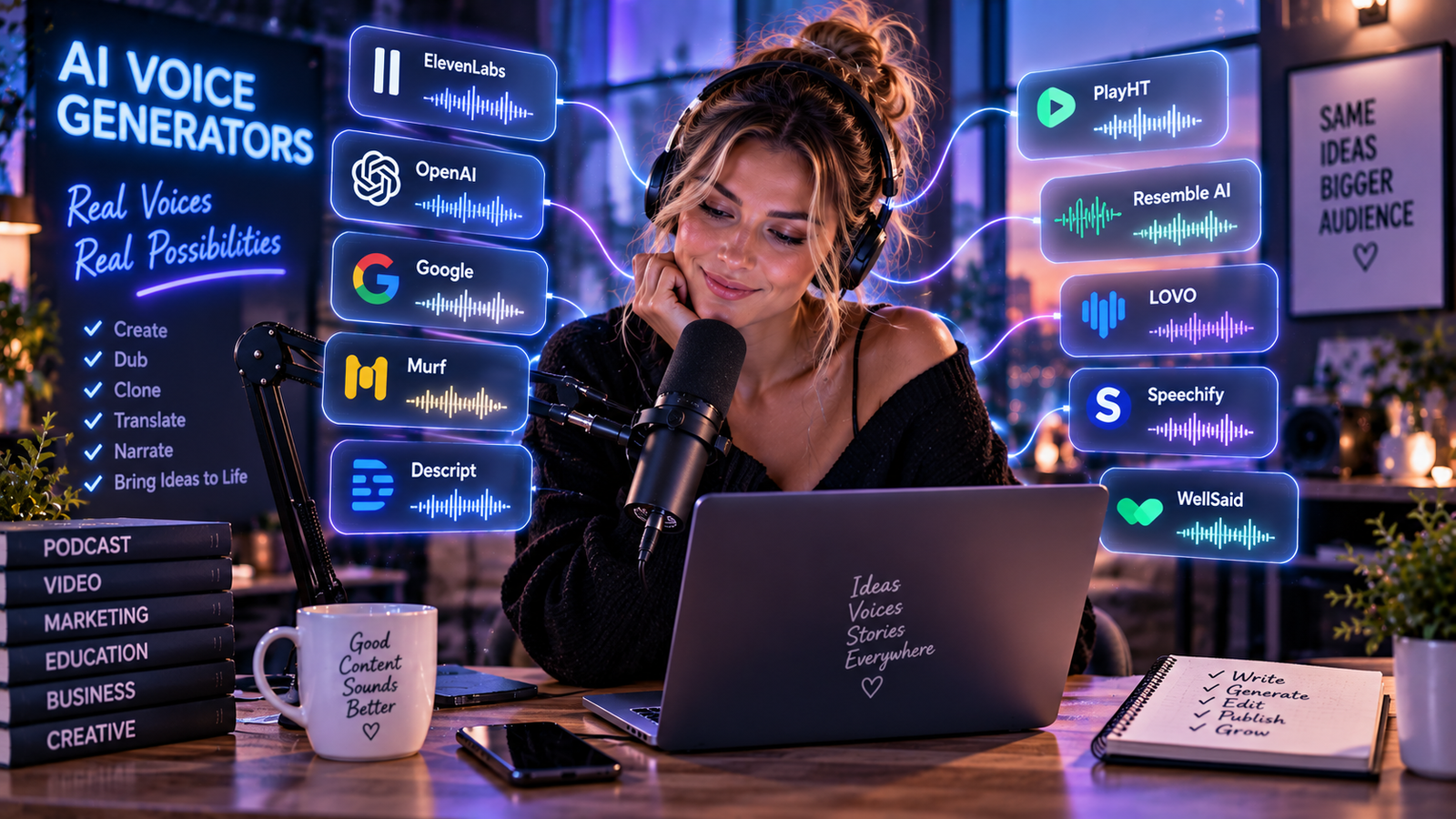
AI-generated voices have improved dramatically.
In 2026, synthetic speech is being used for YouTube videos, podcasts, advertising, training content, customer service, games, localization and real-time AI assistants.
The biggest change is that modern voice systems no longer focus only on sounding clear.
They increasingly try to reproduce emotion, pacing, conversational rhythm, accents and even the performance of the original speaker across different languages.
But the best AI voice generator depends on what you actually need.
Some platforms are strongest for realistic narration. Others specialize in voice cloning, multilingual dubbing, business presentations or real-time conversational AI.
Here are 10 AI voice platforms worth considering in 2026.
Best AI Voice Generators: Quick Comparison
| Platform | Best For | Standout Strength |
|---|---|---|
| ElevenLabs | Overall voice generation | Natural voices, cloning and dubbing |
| OpenAI | Conversational AI voice | Realtime voice interaction |
| Google Cloud TTS | Developer and enterprise use | Gemini-TTS and Chirp 3 HD |
| Descript | Podcast and video editing | Voice editing inside a full editor |
| Murf | Business narration | Presentation and marketing workflows |
| Speechify Studio | Creator narration | Accessible voice production |
| PlayHT | Voice APIs | Developer-focused speech generation |
| Resemble AI | Custom voice applications | Voice cloning and enterprise workflows |
| LOVO | Marketing and creative voiceovers | Voice generation with creator tools |
| WellSaid | Professional business voiceovers | Consistent production-oriented narration |
1. ElevenLabs — Best Overall AI Voice Generator
ElevenLabs remains one of the most recognizable names in AI voice generation.
Its platform combines text-to-speech, voice cloning, speech-to-speech and multilingual dubbing.
For creators, one of its biggest advantages is the ability to move between several different workflows without leaving the same ecosystem.
ElevenLabs' Dubbing v2 can translate audio and video into more than 90 languages while preserving elements of the original speaker's tone, pacing and delivery.
That makes it especially useful for creators and businesses trying to reach audiences in multiple markets.
Best for: narration, voice cloning, multilingual content and dubbing.
Why it stands out: it combines high-quality speech generation with a broad set of production tools.
2. OpenAI — Best for Conversational AI Voice
OpenAI's strongest voice technology is increasingly focused on conversation rather than traditional voiceover production.
Its realtime voice models are designed for natural back-and-forth interaction, including situations where an AI system needs to listen, respond and continue a conversation with low latency.
GPT-Live, introduced in 2026, is built around full-duplex interaction, meaning the system can listen and speak in a more fluid conversational exchange.
OpenAI also offers text-to-speech models through its API for applications that need generated speech without a full realtime conversation.
Best for: voice assistants, interactive applications and realtime AI experiences.
3. Google Cloud Text-to-Speech — Best for Scalable Voice Applications
Google's speech stack has become much more sophisticated than traditional text-to-speech.
Gemini-TTS can generate single-speaker or multi-speaker speech while allowing developers to guide style, pace, tone and emotional expression using natural-language instructions.
Google also offers Chirp 3: HD voices for conversational agents and low-latency applications.
For companies building voice directly into software products, that combination of speech quality and cloud infrastructure can be a major advantage.
Best for: developers, customer-service systems and scalable voice applications.
4. Descript — Best for Editing Voice Inside Audio and Video
Descript approaches AI voice from the perspective of editing.
Its Overdub technology allows users to create synthetic speech from text and use that generated voice to correct or replace spoken sections inside an existing recording.
That is particularly useful for podcasts and videos because fixing one sentence does not necessarily require recording the entire section again.
Descript also combines voice generation with transcription, editing and audio cleanup.
Best for: podcasts, video editing and correcting recorded narration.
5. Murf — Best for Business Voiceovers
Murf is aimed heavily at business and professional narration workflows.
Typical use cases include presentations, training videos, product explainers and marketing content.
Instead of requiring a recording studio for every revision, teams can create and update voiceovers from text.
This can be particularly useful when business content changes frequently and needs to be republished quickly.
Best for: corporate narration, presentations and marketing videos.
6. Speechify Studio — Best for Easy Creator Narration
Speechify is widely associated with text-to-speech, while its creator tools extend that idea into voiceover production.
The appeal is accessibility.
A creator can turn scripts into narration without needing microphones, recording environments or advanced audio production skills.
That makes this category useful for social video, educational material, explainers and other content where speed matters.
Best for: creators and straightforward narration workflows.
7. PlayHT — Best for Voice APIs
PlayHT has built a strong position around synthetic speech and developer access.
Platforms in this category are particularly useful when the goal is not simply downloading a voiceover file but integrating generated speech into another application.
Potential use cases include virtual assistants, interactive products, games and automated customer experiences.
Best for: developers and products requiring programmatic voice generation.
8. Resemble AI — Best for Custom Voice Applications
Resemble AI focuses heavily on custom synthetic voices and enterprise voice applications.
This type of platform can be useful when a company wants a recognizable voice identity instead of relying only on a generic stock voice.
Voice cloning technology also creates additional responsibility, however.
Businesses should have clear permission to create or use a person's synthetic voice and should understand the platform's consent and security requirements.
Best for: branded voices, custom applications and enterprise voice workflows.
9. LOVO — Best for Creative and Marketing Voiceovers
LOVO combines AI voice generation with tools aimed at creators and marketing production.
Rather than treating speech generation as a developer-only technology, platforms like LOVO package it into a visual production workflow.
That can make it easier to create narration for ads, explainers and social content without moving between many separate tools.
Best for: marketing, social content and creative voiceovers.
10. WellSaid — Best for Professional Business Narration
WellSaid focuses on polished AI-generated voices for professional content.
Businesses creating training materials, presentations or recurring branded content often care less about experimenting with unusual voices and more about maintaining consistent, professional narration.
That is where production-focused platforms can have an advantage.
Best for: training, business communication and professional voiceovers.
What Is the Best AI Voice Generator in 2026?
For general voice generation, ElevenLabs remains one of the strongest overall options because it combines natural speech, voice cloning and multilingual dubbing.
For interactive applications where the AI needs to participate in a live conversation, OpenAI and Google's conversational speech technologies belong in a different category from traditional narration tools.
For businesses producing regular presentations and training content, platforms such as Murf and WellSaid may provide a simpler workflow.
And for podcasters and video editors, Descript is particularly interesting because AI voice generation is integrated directly into the editing process.
AI Voice Generation vs Voice Cloning
These terms are often used interchangeably, but they are not the same thing.
AI voice generation creates speech using a synthetic voice supplied or generated by the platform.
Voice cloning attempts to reproduce the characteristics of a specific person's voice from recordings.
Voice cloning can be extremely useful when the speaker has given permission — for example, allowing a creator to fix narration or localize their own content.
It can also be misused.
Users should never clone another person's voice without appropriate permission, and businesses should establish clear consent rules before deploying synthetic voices commercially.
AI Dubbing Is Becoming Much More Natural
Traditional dubbing can require translators, actors, studios and extensive editing.
AI is beginning to compress that workflow.
Modern dubbing systems can translate speech while attempting to preserve the original speaker's style and performance.
ElevenLabs says its Dubbing v2 supports more than 90 languages and carries elements such as tone and pacing across translations.
That has potentially significant implications for creators who want to distribute one video across many countries.
AI Voice for Video Creators
AI video and AI voice generation increasingly belong in the same production workflow.
A creator might generate a visual scene, create dialogue or narration with an AI voice model and then combine the pieces inside an editing platform.
If video generation is also part of your workflow, see our Best AI Video Generators in 2026 comparison.
AI Voice for Small Businesses
Small businesses can use synthetic speech for more than advertising.
Potential applications include training material, customer information, product explainers, onboarding videos and multilingual content.
Businesses exploring AI across their broader operation can also read our Best AI Tools for Small Business in 2026 guide.
What Should You Look for in an AI Voice Generator?
Before choosing a platform, consider:
- how natural the voice sounds,
- how much control you have over tone and delivery,
- supported languages,
- voice cloning options,
- dubbing capabilities,
- commercial-use terms,
- API access,
- and consent requirements for custom voices.
A platform with hundreds of voices is not automatically better than one with fewer voices if the final speech does not fit your content.
How We Selected These Tools
This guide focuses on AI voice platforms relevant to current creator, business and developer workflows.
We considered areas including:
- voice naturalness,
- speech control and emotional range,
- voice cloning,
- multilingual support and dubbing,
- creator and business workflows,
- developer integration,
- and the broader tools available around voice generation.
Features and pricing change quickly, so users should confirm current plans and usage rights directly with each provider before committing to a production workflow.
Final Verdict
AI voice generation in 2026 is becoming much broader than basic text-to-speech.
ElevenLabs is one of the strongest overall platforms for creators who need realistic voices, cloning and dubbing in one place.
OpenAI is particularly interesting for realtime conversational experiences, while Google offers sophisticated speech technology for developers and large-scale applications.
Descript stands out when voice generation needs to be part of an audio or video editing workflow.
The right choice ultimately depends on whether you are creating a voiceover, cloning your own voice, translating existing content or building an application that needs to speak naturally with users.
For a broader overview of creative AI software, see our Best AI Tools in 2026 guide.