The AI Tools Actually Worth Using in 2026
“The AI tool market is crowded. These are the categories and platforms that are actually changing how people research, create, code and get work done in 2026.”
The AI tool market has changed
There was a time when choosing an AI tool mostly meant choosing a chatbot.
That is no longer the case.
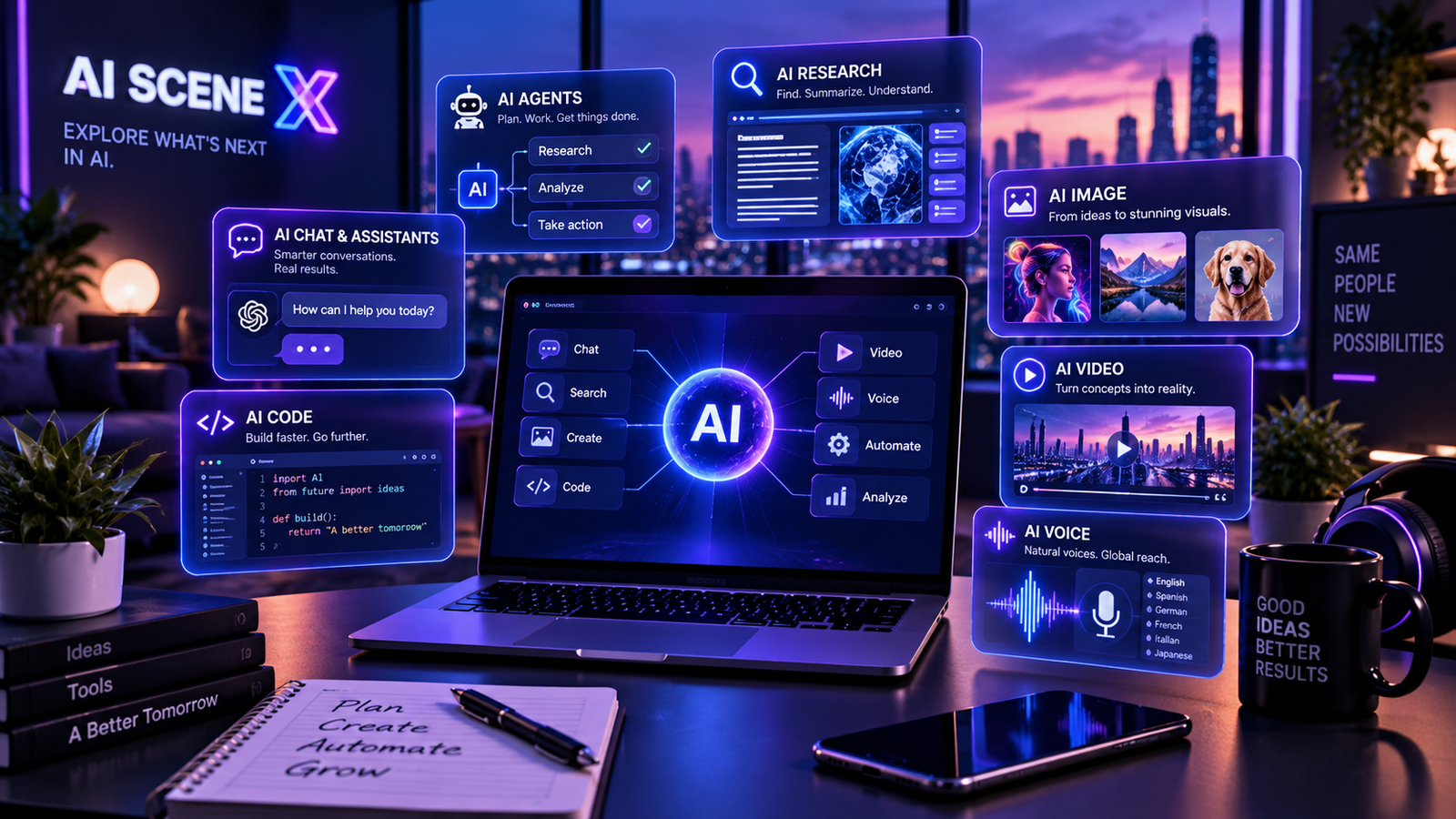
In 2026, the most useful AI products are increasingly built around complete workflows. They do not simply generate an answer. They research, write, analyze files, work with code, create media and connect with other software.
The result is an enormous and sometimes confusing market.
Thousands of AI products now compete for attention, but most people do not need dozens of subscriptions. The important question is simpler: which types of AI tools are actually useful?
Here are the categories worth watching.
General-purpose AI assistants
General AI assistants remain the best starting point for most users.
Products such as ChatGPT, Claude and Gemini have evolved far beyond basic question-and-answer interfaces. They increasingly combine research, reasoning, coding, document analysis, images and tool use inside one workspace.
The important change is not simply that the models are becoming smarter. Their interfaces are becoming places where work actually happens.
That makes a strong general-purpose assistant more valuable than collecting ten specialized tools that perform only one task.
AI agents
Agents are one of the biggest changes in the AI software market.
Traditional chatbots wait for instructions and return an answer. Agents can take a goal, break it into steps and interact with tools or external applications to complete the task.
Real-world agent activity increasingly spans communication, productivity, CRM, project management and other business applications rather than staying inside a single chat window.
This creates an entirely different relationship with software.
Instead of asking AI how to perform a task, users increasingly ask AI to perform the task.
That distinction may eventually become more important than which underlying language model an application uses.
AI coding tools
Software development has become one of the clearest examples of this shift.
Modern coding assistants can inspect repositories, modify multiple files, run commands, identify errors and work through larger development tasks.
The category now includes both AI-enhanced editors and terminal-based coding agents. Current September rankings show products such as Cursor and Claude Code competing around these different workflows rather than simply offering autocomplete.
For developers, the question is increasingly not whether to use AI, but how much autonomy to give it.
Human review still matters. But the productivity difference between traditional autocomplete and an agent capable of handling a multi-file task can be enormous.
AI research tools
Research is another area where AI has become genuinely useful.
The best research systems do more than produce plausible answers. They search multiple sources, organize findings and provide citations that allow users to inspect the original material.
This is particularly valuable when comparing products, researching companies, studying unfamiliar industries or collecting background information quickly.
But citations matter.
AI-generated research should still be verified against primary sources, particularly for financial, medical, legal or rapidly changing information.
Speed is useful. Verifiability is more useful.
AI image generation
Image generation has moved from novelty to production tool.
Creators now use generative image systems for concept art, advertising, product visualization, social media, storyboards, website assets and personalized content.
The quality gap between early AI images and modern generation systems is dramatic.
But the next stage is not simply higher resolution.
Control is becoming the important feature: maintaining characters, editing specific parts of an image, preserving visual identity and moving between generation and editing without rebuilding everything from scratch.
That makes AI imagery increasingly useful inside professional creative workflows.
AI video
Video remains one of the fastest-moving categories.
Generation quality has improved substantially, while workflows combining images, animation, speech and video generation are becoming easier to use.
For creators and businesses, that lowers the cost of producing short promotional clips, product concepts and social content.
The technology is still imperfect. Long scenes, physical consistency and precise control can remain challenging.
But short-form AI video has already crossed an important threshold: it is useful now, not merely impressive as a demonstration.
AI voice and audio
Synthetic voice has undergone a similar transformation.
Modern systems can produce increasingly natural speech, clone permitted voices, translate spoken content and generate audio in multiple languages.
This is changing workflows for video creators, education, customer service, podcasts and localization.
It also creates obvious questions around consent and identity.
As synthetic voices become harder to distinguish from recordings, responsible platforms will need stronger disclosure and permission systems.
AI productivity tools
The most interesting productivity products may eventually become the least visible AI products.
Instead of opening another chatbot, AI is being embedded into email, meetings, calendars, documents, spreadsheets and business applications.
The goal is simple: remove repetitive work.
Meeting summaries, email drafting, document analysis, scheduling and information retrieval are increasingly becoming background AI functions rather than standalone products.
That may be where AI delivers some of its largest everyday productivity gains.
Don’t collect AI tools. Build a stack.
The temptation in 2026 is to subscribe to everything.
That is usually a mistake.
A better approach is to build a small AI stack around the work you actually do.
For many people that could mean one general assistant, one research tool and one specialized product for their primary profession.
A developer may add a coding agent.
A designer may add an image generator.
A video creator may prioritize video and voice.
A business may care more about automation and agents.
The best AI tool is not necessarily the product with the largest model or the longest feature list.
It is the one that removes meaningful work from your day.
What comes next
The AI tools market is gradually moving away from individual applications and toward connected systems.
Models are becoming agents. Agents are connecting to software. Software is becoming increasingly conversational.
That means the next major AI product may not look like another app at all.
It may simply be an intelligent layer capable of working across the applications people already use.
And that is why the most important AI tool trend of 2026 is not another chatbot.
It is the transition from AI that answers to AI that acts.